
Gino Severini
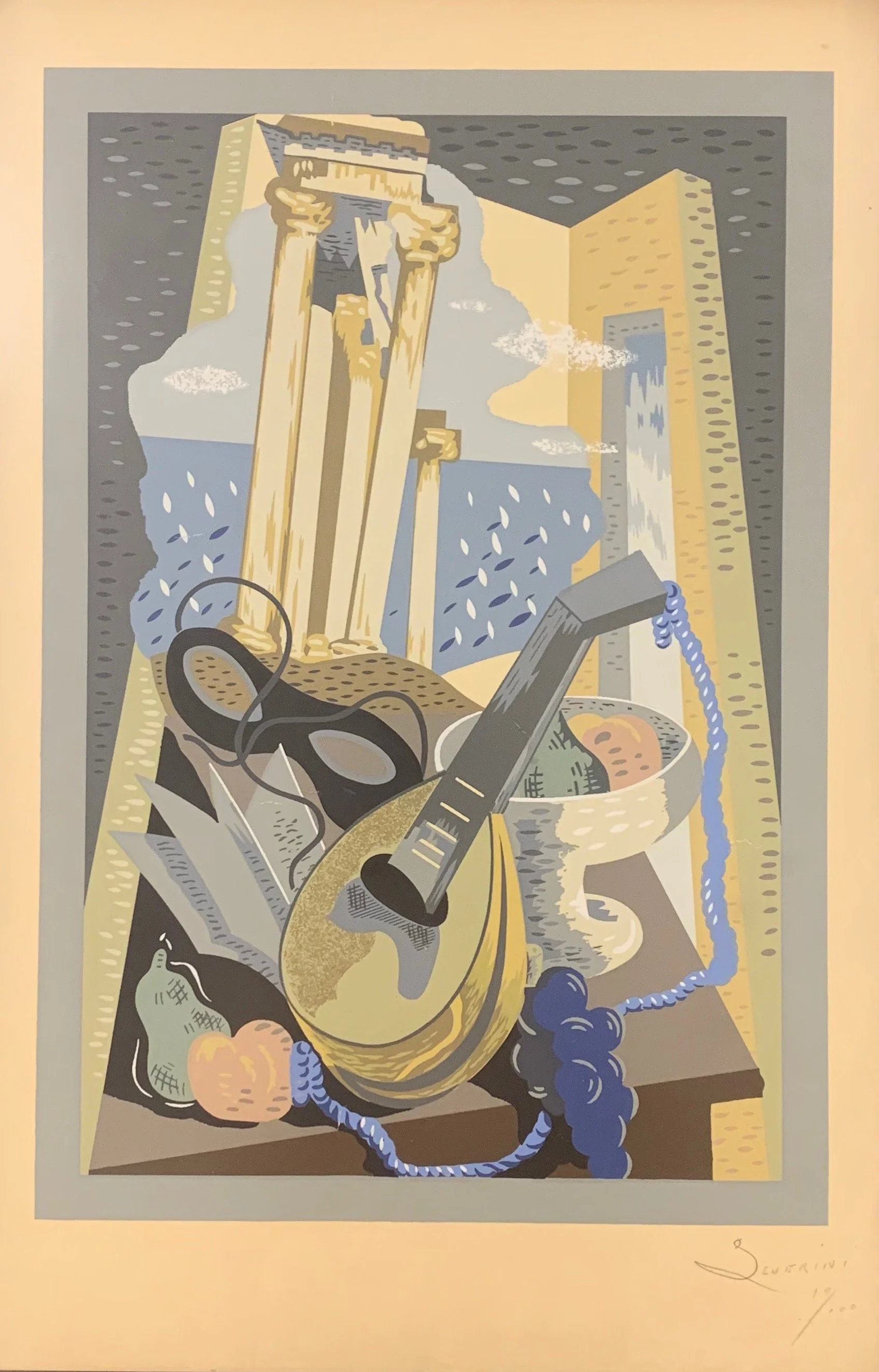
Still Life Lithograph 17 x 11.5 inches
b. 1883, Cortona, Italy,
d. 1966, Paris, France
Gino Severini was an Italian painter and a leading figure of the Futurist movement. Born in Cortona on April 7, 1883, he moved to Rome in 1899, where he attended evening classes at the Villa Medici. After meeting Giacomo Balla and Umberto Boccioni, Severini began working as an artist in 1901. Balla introduced him to the Divisionist color techniques of the Neo-Impressionists.
In 1906, Severini moved to Paris, where he studied the Impressionists and developed an interest in the work of Georges Seurat and Paul Signac. During this period, he became associated with many of the leading artists and intellectuals of the time, including Amedeo Modigliani, Pablo Picasso, Georges Braque, and Juan Gris.
Invited by Filippo Tommaso Marinetti and Boccioni to join the Futurist movement, Severini signed the Manifesto of Futurist Painting on February 11, 1910, becoming one of the movement’s founding artists. Unlike many of his Futurist contemporaries, Severini focused less on machines and industrial subjects, and more on the movement of the human figure. His celebrated cabaret scenes and depictions of dancers, including Blue Dancer (1912), exemplify the Futurist interest in motion, faceting, and simultaneous visual effects.
Severini exhibited in major Futurist exhibitions in Paris, London, and Berlin in 1912, helping to strengthen artistic connections between Italy and France. After 1915, his work increasingly reflected Cubist influences and a growing interest in geometric harmony and classical structure. Still lifes with musical instruments and scenes inspired by the Commedia dell’Arte became recurring subjects in his work.
Between 1924 and 1935, Severini completed numerous murals and mosaics while continuing to divide his time between Rome and Paris. He also published several theoretical texts on modern art. In 1950, he was awarded the Grand Prize at the Venice Biennale.
Throughout his career, Severini explored the relationship between light, movement, memory, and structure, combining Divisionist color with Cubist and Futurist forms in a highly distinctive style. Important works by the artist are now held in major collections, including the Gianni Mattioli Collection in Milan and the Museum Boijmans Van Beuningen in Rotterdam.