
Ben Shahn
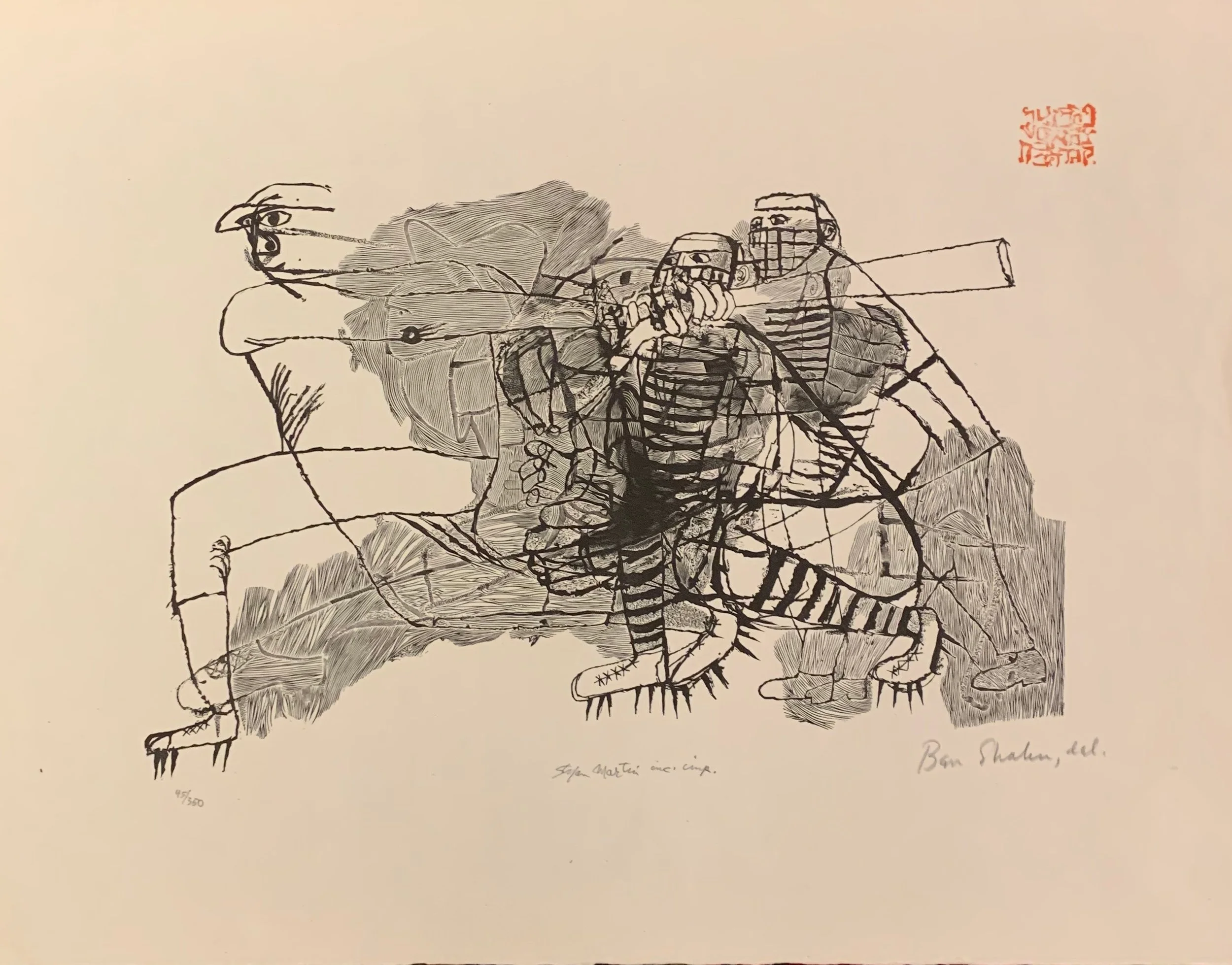
Baseball Engraving 21 x 26 ½ inches
b. 1898, Kaunas, Lithuania
d. 1969, New York, NY
A painter, teacher, graphic artist, and photographer, Ben Shahn was devoted to the figurative tradition and became one of the most significant social critics among twentieth-century American artists.
Born in Kaunas, Lithuania on September 12, 1898, Shahn emigrated with his family to the United States in 1906. From the ages of fifteen to eighteen, he apprenticed with a New York lithographer. In 1919, he enrolled at New York University and completed his studies at the City College of New York in 1924. After two years at the National Academy of Design, Shahn traveled through Europe and North Africa before returning to the United States, where he held his first one-man exhibition in 1929.
Shahn’s mature style and emphasis on social themes emerged during the 1930s. His work was influenced in part by photographer Walker Evans, with whom he shared studio space. Between 1931 and 1932, Shahn created a series of gouaches and mural panels based on the Sacco and Vanzetti case. The best known, The Passion of Sacco and Vanzetti, is regarded as one of his most important works, notable for its restrained emotion, elongated figures, and subtle caricature.
A related series of gouache studies addressing labor leader Tom Mooney attracted the attention of Mexican muralist Diego Rivera, leading Shahn to assist Rivera on the RCA Building murals at Rockefeller Center in New York.
During the 1930s, Shahn created murals and paintings for several Federal arts programs, incorporating techniques learned from Rivera while developing a more direct and accessible visual language. Addressing themes ranging from antisemitism to labor inequality, his work combined strong narrative structure with social commentary. He also produced notable documentary photographs for the Farm Security Administration, including Arkansas Sharecropper’s Family.
During the 1940s, Shahn designed graphics for the Office of War Information and later for the Congress of Industrial Organizations (CIO). His 1944 poster Register, Vote reflects both his commitment to social equality and his ability to integrate text and image into a unified design.
In 1947, the Museum of Modern Art in New York organized a major retrospective exhibition of his work.
After the 1940s, Shahn moved from what he termed “social realism” toward a more symbolic and personal style while continuing to explore universal human experience through stylized line, vivid color, and allegory. Works such as Blind Botanist (1954) exemplify his ability to convey the poignancy and vulnerability of the human condition.
His Lucky Dragon series (1960–1962), inspired by the Japanese fishing vessel exposed to atomic testing in 1954, further demonstrated his continued engagement with contemporary social and political issues. Among his many honors was his appointment as Charles Eliot Norton Professor of Poetry at Harvard University in 1956–1957. Throughout his later years, Shahn continued to paint, lecture, and teach extensively.
His work is represented in numerous major public and private collections, including the Smithsonian American Art Museum, the Metropolitan Museum of Art, the Art Institute of Chicago, the National Gallery of Art, the Brooklyn Museum, the Museum of Modern Art, and the Whitney Museum of American Art.