
Leonard Baskin
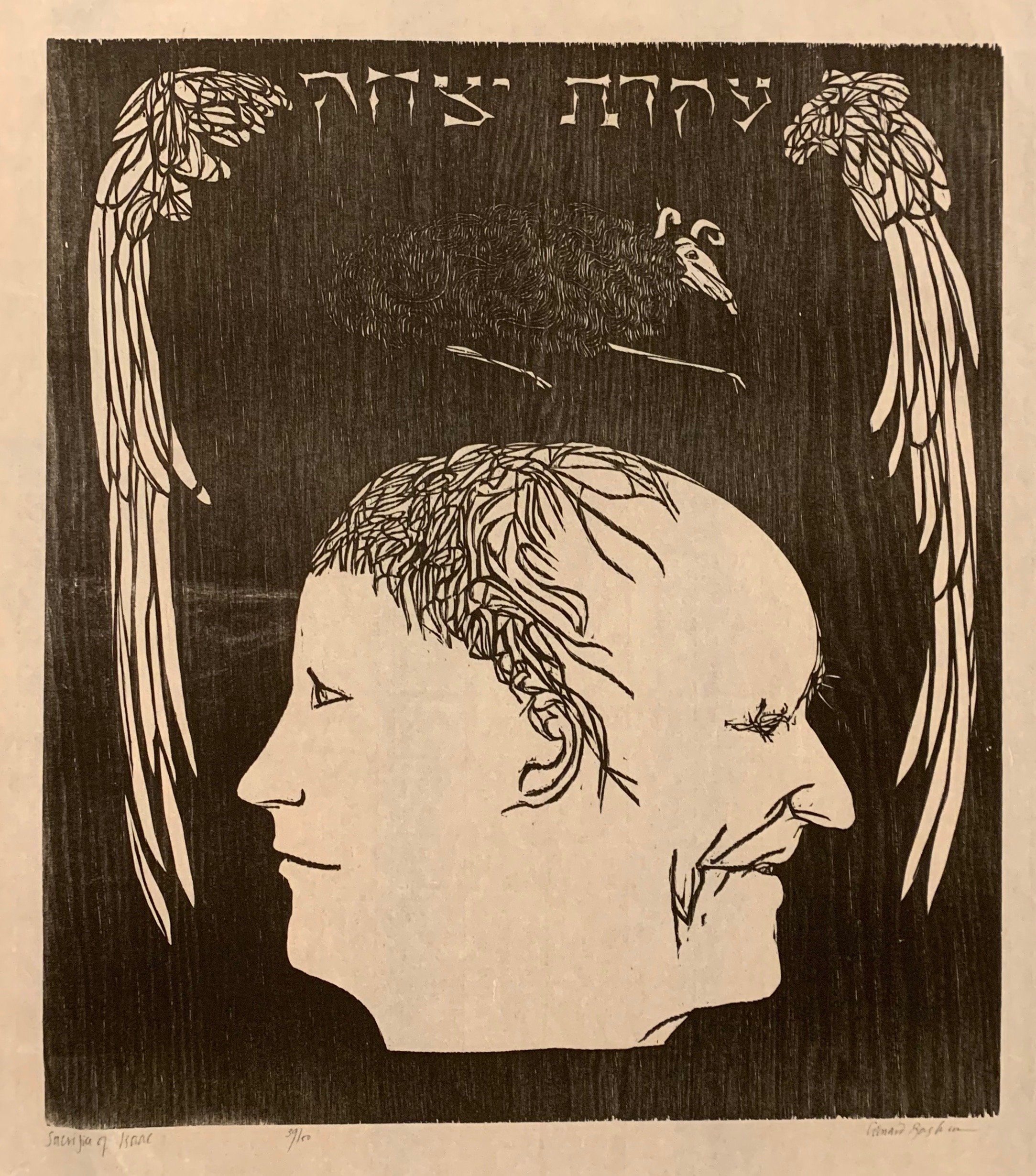
The Sacrifice of Issac, 1960 Woodcut 17 x 15 inches
b. 1922, New Brunswick, NJ
d. 2000, Northampton, MA
Leonard Baskin was born in 1922 in New Brunswick, New Jersey, to Rabbi Samuel Baskin and May Guss Baskin. Religious themes, mythological symbolism, and images of human nature have been entwined throughout his career, serving as the subjects of many of his works. Baskin became intrigued by Greek history, philosophy, and mythology at an early age—the sibyl, a prophetic female figure in Greek mythology, is the central subject of many of his sculptures and paintings.
Perhaps Baskin’s best-known image is the bird, either as a subject in itself or as a form of life emanating from humanity, or as a caricature of perceived human ills. “The link between Baskin’s images is his humanism. His sculpture of the human figure depict the grace and mystery of woman, pay homage to man the individual. Other works, in sculpture and on paper, portray the evil side of humankind. Although Baskin treats the frailties and injustice of humankind in all media, his caring for human beings and the human condition is ever present.”
Baskin’s sculpture, watercolors, and prints are in the permanent collections of most of the world’s major art galleries and museums, including the Metropolitan Museum of Art, The Museum of Modern Art, the Vatican Museum, and the Smithsonian. Leonard Baskin’s main focus throughout his life was sculpture: “My sculptures are memorials to ordinary human beings, gigantic monuments to the unnoticed dead: the exhausted factory worker, the forgotten tailor, the unsung poet… Sculpture at its greatest and most monumental is about simple, abstract, emotional states, like fear, pride, love, and envy… Over the years, I have developed a series of images of predatory birds and vicious human beings, as well as producing a bizarre motley of iconic devices that say…BASKIN!”
Source: Payson, John Whitney. Angel to the Jews. Place of publication: Publisher, 1991.