
Theodore Clement Steele
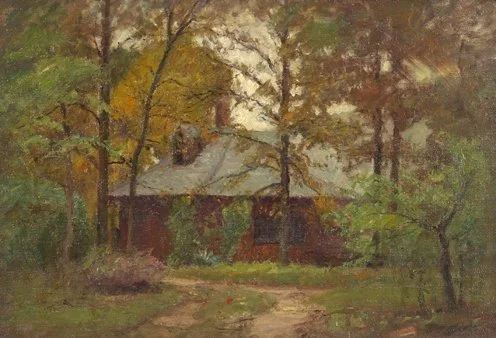
House of the Singing Winds Oil on canvas 21 x 32 inches
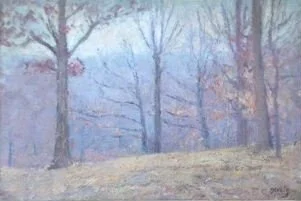
Autumn, 1925 Oil on canvas 15 x 22 inches
b. 1847, Owen County, IN
d. 1926, Owen County, IN
Theodore Clement Steele was born in Owen County, Indiana, and died in Brown County, Indiana.
One of the leading proponents of Impressionism in the Midwest, Theodore Steele became a central figure of the Hoosier School, a group of Indiana painters regarded as the first Midwestern Impressionists. Their favorite place to paint was Brown County, where artists frequently gathered at Steele’s home, known as the “House of the Singing Winds.”
Born near Waveland, Indiana, Steele began his career as a portrait painter before gradually turning toward landscape painting. In 1873, he moved to Indianapolis, where he developed a close friendship with Herman Lieber, who became an important patron. Steele studied at the Indiana School of Art under John Love, who had trained with Jean-Léon Gérôme in Paris and had also painted at Barbizon.
With financial support from Lieber, Steele and his family traveled to Europe, where he chose to study in Munich alongside prominent American painter Frank Duveneck. There, he studied under Ludwig Loefftz and absorbed the darker tonal qualities associated with the Munich School.
After returning to Indianapolis in 1885, Steele established an art school with fellow artist William Forsyth. While his early work reflected the dramatic tonalism of Munich painting, his growing fascination with the Indiana landscape gradually led him toward a brighter palette and a more Impressionistic style.
By 1893, Steele was exhibiting Impressionist paintings at the World’s Columbian Exposition in Chicago and had emerged as a leading voice for Midwestern Impressionism. In 1896, he publicly defended Impressionism in a well-known debate with conservative painter Francis Hopkinson Smith. Steele and his contemporaries later organized the Society of Western Artists to promote modern art in the Midwest.
In 1906, after the death of his first wife, Steele remarried and settled permanently in Brown County. From that time until his death in 1926, he remained one of the most influential figures in Indiana art. In 1910, the John Herron Art Institute in Indianapolis organized a major one-man exhibition of his work, by then fully committed to Impressionism.
Steele also taught at the Waveland Collegiate Institute from 1865 to 1868 and later served as honorary professor of art at Indiana University from 1921 until his death.