
Charles Marian Russell
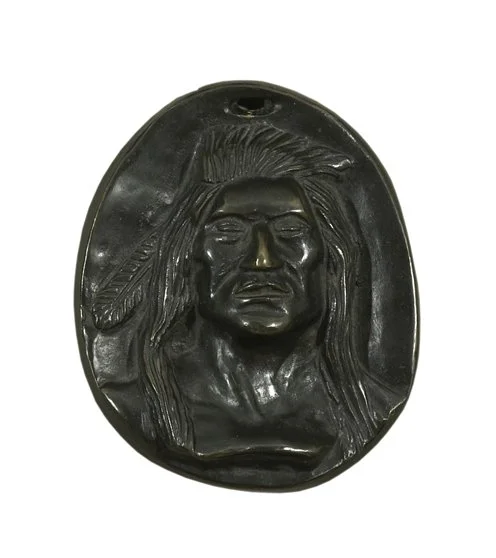
Native American Head I Bronze 4 x 3 inches
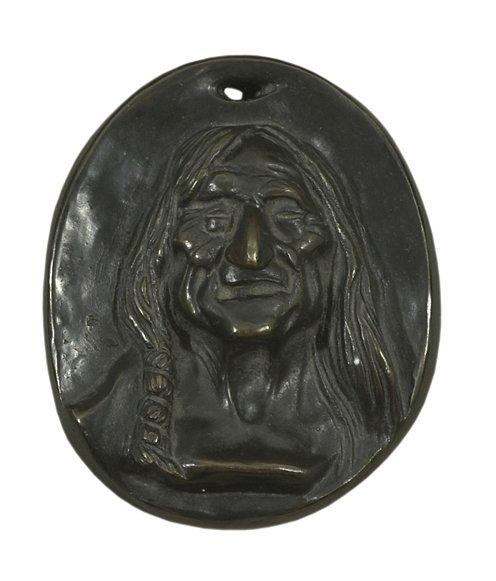
Native American Head II Bronze 4 x 3 inches
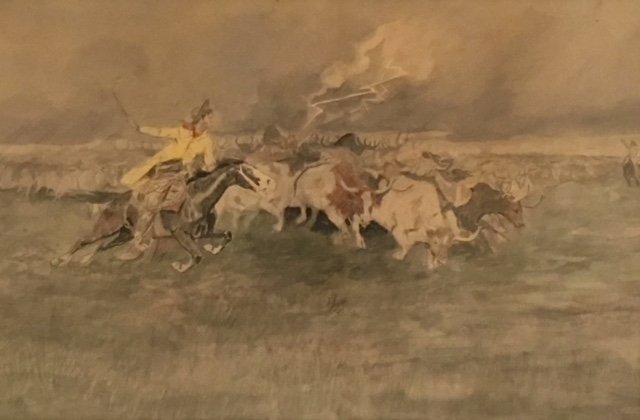
The Stampede, 1889 Watercolor on paper 20 x 30 inches
b. 1864, St. Louis, MO
d. 1926, Great Falls, MT
Charles Marion Russell was born in St. Louis, Missouri, and became a legendary painter and sculptor of frontier life in the American West. Unlike his well-known counterpart Frederic Remington, Russell preferred to paint Native Americans and cowboys rather than cavalrymen.
From an early age, he was fascinated by western life and stories of Indian fighting involving his great-uncle, Will Bent. Russell’s earliest paintings depicted war-bonneted Native Americans on horseback. Uninterested in school, he left home for Helena, Montana, at the age of sixteen, encouraged by his father, who believed the harsh realities of the West would dispel the boy’s romantic notions. Instead, Russell fell completely in love with the western landscape and way of life.
He found work as a night wrangler, leaving his days free for observation and painting. During seven years working cowboy jobs, he carried watercolors in his bedroll and also modeled wildlife in clay. He produced numerous profile paintings and sold his early works among cowboys for five and ten dollars each.
In 1887, Russell declined an opportunity to study in Rome in order to spend the winter with the Blood Indians in Canada. He became deeply sensitive to the plight of Native Americans and respectful of their traditions.
In 1888, Harper’s Weekly published one of his cowboy paintings, and he spent that winter among the Blackfeet Indians of Alberta. He studied their language and ceremonies, and according to accounts from the period, a chief unsuccessfully encouraged Russell to take an Indigenous wife. In 1890, a folio of fourteen of his paintings was published, and that same year he created a mural of ranch-life scenes for the iron doors of a bank in Lewistown, Montana.
It was not until the fall of 1896 that Russell fully committed himself to art as a professional career. That year he married Nancy Cooper, who devoted herself to advancing his career. She encouraged him to establish a studio and pursue commissions, eventually becoming his business manager. Much of Russell’s professional success has been attributed to her marketing and organizational skills.
In the years that followed, Russell’s popularity as an illustrator and painter increased dramatically, despite having received only three formal drawing lessons. His depictions of men and wildlife confronting the hardships of the West appealed to Hollywood celebrities, wealthy collectors, and others drawn to images of the “Wild West.”
In the early 1900s, Russell and his wife visited Yellowstone National Park, inspiring illustrations for Carrie Strahorn’s Fifteen Thousand Miles by Stage. He regarded the park as a refuge for wildlife and strongly opposed recreational hunting. Although Russell apparently visited Yellowstone only once, in 1902, Nancy Russell later returned in 1915 to organize an exhibition of his work, which was well received.
Russell traveled frequently throughout the West, and his Arizona painting Navajo Trackers is believed to be his last completed work. He died of heart failure in Great Falls, Montana, on October 24, 1926. During the final seven years of his life, he spent his winters in Pasadena, California.
Sources:
Falk, Peter Hastings. Who Was Who in American Art. Madison, CT: Sound View Press, 1985.
Phoenix Art Museum docent files.
Hassrick, Peter H. Drawn to Yellowstone: Artists in America’s First National Park. Seattle: University of Washington Press, 2002.
Ballinger, James K. Visitors to Arizona, 1846–1980. Phoenix: Phoenix Art Museum, 1980.